Table of Contents
1. Overview of Gas Fired Steam Boiler
2. Core Working Principle of Industrial Gas Steam Boiler
3. Key Technical Parameters & Efficiency Data Comparison
4. Main Types of Gas Fired Steam Boiler
5. Common Industrial Applications
6. Core Advantages of Natural Gas Steam Boiler
7. Frequently Asked Questions
1. Overview of Gas Fired Steam Boiler
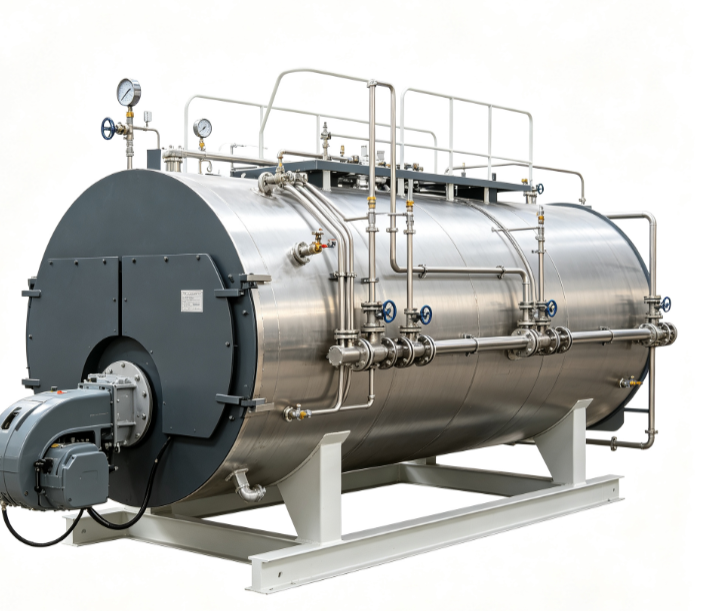
Gas fired steam boiler is a common industrial thermal equipment. It uses clean gas fuels to produce high-pressure steam for industrial production and commercial heating.
Common fuel options include natural gas, LPG and propane. These boilers replace traditional coal-fired equipment in most modern factories. They meet strict environmental emission standards in global industrial zones.
Industrial gas steam boiler units work stably under long-term continuous load. They become the mainstream steam supply solution for food processing, chemical and pharmaceutical industries.
2. Core Working Principle of Industrial Gas Steam Boiler
2.1 Basic Operation Logic
The boiler burner mixes gas fuel with air in a proper ratio. The mixed fuel burns fully inside the furnace. It releases massive heat energy.
Heat transfers to boiler water through heat exchange tubes. Water heats up and evaporates to form saturated steam. The steam outputs through pipelines for end use.
2.2 Heat Recovery Mechanism
Most modern gas fired steam boilers adopt three-pass wet-back structure. Flue gas passes through multiple heat exchange areas.
Residual heat in flue gas is recycled to heat feedwater. This simple design cuts fuel waste a lot. It greatly improves overall thermal efficiency.
3. Key Technical Parameters & Efficiency Data Comparison
The following table shows core performance data of mainstream gas steam boiler models. It also compares with oil-fired and coal-fired boilers for clear reference. All data comes from 2026 industrial boiler industry test reports.
Boiler Type | Thermal Efficiency | NOx Emission (mg/m³) | Fuel Cost (USD/h, 10T/H Load) | Continuous Working Stability |
Gas Fired Steam Boiler | 92% - 96% | <30 | 85 - 92 | High (24h stable operation) |
Oil Fired Steam Boiler | 88% - 91% | 50 - 80 | 110 - 125 | Medium |
Coal Fired Steam Boiler | 78% - 85% | 150 - 200 | 70 - 80 | Low (frequent maintenance) |
Data shows gas fired steam boiler has the highest efficiency among the three types. Its emission index is far lower than traditional boilers.
Though its fuel cost is slightly higher than coal-fired boilers, it saves much maintenance cost. It also avoids environmental penalty fees. The comprehensive economic benefit is better.
4. Main Types of Gas Fired Steam Boiler
4.1 WNS Horizontal Gas Steam Boiler
This is the most widely used model. It has horizontal fire tube structure. It supports 0.5T/H to 20T/H steam output.
It fits small and medium industrial scenarios. It features simple structure and easy daily operation.
4.2 Vertical Low NOx Gas Boiler
Vertical design saves installation space. It adopts ultra-low NOx burner technology.
It suits factories with strict environmental requirements. It is common in urban industrial parks and food factories.
4.3 Condensing Gas Steam Boiler
This model adds condensing heat recovery device. It absorbs latent heat from flue gas.
Its thermal efficiency can reach over 95%. It is the most energy-saving type for long-term operation.
5. Common Industrial Applications
Gas fired steam boiler provides stable steam supply for multiple industries. It covers most industrial thermal demand scenarios.
Food and beverage industry uses it for raw material sterilization and production line heating.
Chemical industry relies on its high-temperature steam for raw material reaction and distillation processing.
Pharmaceutical factories use clean gas steam to meet sterile production standards.
Textile and printing industries need constant steam temperature for fabric processing and drying work.
6. Core Advantages of Natural Gas Steam Boiler
First, it has clean combustion performance. Gas fuel burns fully with no solid waste. It produces little harmful gas.
Second, it runs with high automation. Automatic water supply and temperature control reduce manual operation errors.
Third, it has fast heating response. It can reach rated steam pressure in short time. It adapts to fluctuating production load.
Fourth, daily maintenance is simple. It has no ash cleaning and slag removal work. It cuts long-term operation cost.
7. Frequently Asked Questions
Q1: What fuel can a gas fired steam boiler use?
It mainly uses natural gas and LPG. Some models also support propane and biogas. All gaseous clean fuels with stable combustion can match the equipment.
Q2: What is the normal service life of an industrial gas steam boiler?
With regular maintenance, its service life can reach 15 to 20 years. Daily water treatment and regular burner inspection are key to extend service life.
Q3: Is low NOx transformation necessary for old gas steam boilers?
Yes. Most regional environmental regulations require NOx emission below 30mg/m³. Old equipment cannot meet the standard. Simple burner transformation can solve the problem effectively.
Q4: What steam pressure do mainstream gas boilers support?
Common working pressure ranges from 0.7MPa to 1.6MPa. It can meet most medium and low pressure steam demand of industrial production.