Table of Contents
1. Introduction
2. Basic Classification of Common Biomass Fuel for Biomass Boilers
3. Working Characteristics of Rice Husk Boiler, Wood Chip Boiler and Straw Boiler
4. Combustion Efficiency Comparison of Different Biomass Fuel Types
5. Biomass Boiler Emission Performance Analysis
6. Authoritative Industry Test Data Comparison Table
7. Fuel Selection Suggestions for Different Working Conditions
8. Conclusion
9. Industry FAQ
1. Introduction
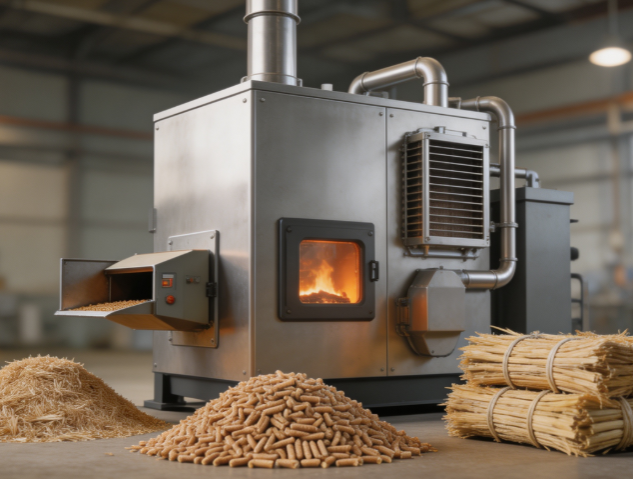
Biomass boilers have become one of the most widely used clean energy heating equipment in industrial production.
Unlike traditional coal-fired equipment, these boilers support a variety of agricultural and forestry residual biomass fuel.
Many users ignore fuel adaptability, resulting in low combustion efficiency and excessive flue gas emission.
Different fuels such as rice husk, wood chips and crop straw match different boiler structures.
A clear understanding of fuel characteristics can maximize biomass boiler operating performance.
2. Common Biomass Fuel Types for Industrial Boilers
The mainstream biomass fuel in the market mainly comes from agricultural and forestry waste resources.
Rice husk, wood chips and crop straw are the three most widely applied raw materials.
Each fuel has unique calorific value, moisture content and ash content attributes.
These physical parameters directly decide the final combustion state and emission level.
3. Operational Characteristics of Different Biomass Boilers
3.1 Rice Husk Boiler Features
Rice husk boiler uses rice processing waste as the main fuel source.
Rice husk features low density and easy combustion, but it produces more ash content.
This type of biomass boiler is suitable for grain processing factory self-power supply scenarios.
3.2 Wood Chip Boiler Features
Wood chip boiler takes crushed wood scraps, branches and wood residues as fuel.
Wood biomass fuel owns stable calorific value and low impurity content.
It maintains high combustion efficiency under long-term continuous operation.
3.3 Straw Boiler Features
Straw boiler uses crop straw after crushing and bundling as combustion raw material.
Straw fuel is cheap and easy to obtain, but the moisture fluctuation range is large.
Unprocessed straw will cause unstable combustion and increased exhaust emission.
4. Combustion Efficiency Analysis of Different Fuels
Combustion efficiency is the core index to evaluate biomass boiler energy utilization.
Wood chip fuel has uniform texture and stable heat release, with the highest efficiency.
Rice husk burns fast but has heat loss due to loose structural characteristics.
Straw fuel with excessive moisture will seriously reduce the overall thermal efficiency.
5. Biomass Boiler Emission Performance Comparison
Biomass boiler emission mainly includes particulate matter, NOx and tiny smoke dust.
High-purity wood chips produce fewer harmful substances after full combustion.
Straw and rice husk contain more alkali metal components, leading to slightly higher emissions.
Standard flue gas treatment can make all fuel types meet international environmental standards.
6. Industry Authoritative Test Data Comparison
The following data is cited from IEA 2025 Industrial Biomass Energy Equipment Performance Report. All data are tested under standard industrial operating conditions, which truly reflect the actual performance of different biomass fuels.
Fuel Type | Average Combustion Efficiency | PM2.5 Emission (mg/m³) | NOx Emission (mg/m³) | Fuel Moisture Adaptability |
Wood Chip | 92.7% | 18.6 | 45.2 | Strong |
Rice Husk | 87.3% | 25.4 | 53.7 | Medium |
Crop Straw | 83.5% | 32.1 | 61.4 | Weak |
The data clearly shows that wood chip biomass fuel has the best comprehensive performance, while straw fuel needs preprocessing to improve efficiency and reduce emissions.
7. Fuel Selection Guidance for Industrial Scenarios
For high-load and stable production, wood chip boiler is the most reliable choice.
Grain processing enterprises can prefer rice husk boiler to reuse waste resources.
For rural centralized heating, straw boiler with drying pretreatment is more cost-effective.
Matching the right fuel can greatly reduce operating costs and optimize emission indicators.
8. Conclusion
Different biomass fuel types bring huge differences in biomass boiler performance.
Wood chips, rice husk and straw have their own advantages in efficiency and emission.
Reasonable fuel matching and pretreatment can maximize boiler combustion efficiency.
It also realizes low-emission and energy-saving operation of biomass boilers.
9. Industry FAQ
Q1: Which biomass fuel has the highest combustion efficiency?
A1: Wood chip fuel maintains the highest combustion efficiency and stability. Its uniform texture, low impurity and stable calorific value make wood chip boiler perform better in continuous industrial operation.
Q2: Why straw boiler has relatively higher emissions?
A2: Crop straw contains more alkali substances and volatile components. Unprocessed straw with high moisture causes insufficient combustion, which increases flue gas particulate and nitrogen oxide emissions.
Q3: Is rice husk boiler suitable for long-term industrial operation?
A33: It is suitable for auxiliary heating of grain factories with sufficient rice husk resources. But regular ash cleaning is required to avoid efficiency attenuation caused by ash accumulation.
Q4: How to reduce biomass boiler emission effectively?
A4: Adopt fuel drying and crushing pretreatment, optimize boiler air supply parameters, and equip with standard flue gas purification equipment to achieve ultra-low emission standards.